The Elimination Concept
The pharmacokinetic parameter that quantifies drug elimination, is called clearance (CL).
CL describes the relationship between concentration and the rate of elimination of drug from the body. Note that elimination and clearance are NOT the same thing.
On a related note, the fact that CL is made-up and has no physical meaning is an important concept to understand. CL is more a consequence of the underlying mathematics of pharmacokinetics than a real biological process. A number of experimental observations in the late 1960s, early 1970s, could not be explained by the pharmacokinetic theory available at the time. Researchers used concepts from the oil industry to explain the clearence of drug from the body. What’s more, CL is near impossible to interpret on its own, but somehow is still common to see in the summary of product characteristics for approved drugs.
A more intuitive parameter is the half-life (t1/2), which is the time it takes for the concentration of a drug to decrease by half. However, even if the half-life is more intuitive, it is not very useful during the current state of modern drug developement. The half-life of a drug is really only useful if a drug follows one-compartment PK with linear elimination, which is rare for modern drugs.
A better way to illustrate drug elimination, would be through typical PK predictions, and/or simulations. In the therapeutic context of the drug, what elimination characteristics would be clinically useful to understand? These characteristics can be quantified through deterministic predictions (no variability) or stochastic simulations (with variability).
\[ \CL = \mathrm{R}_\text{elimination} / \C \] \[ \fe + \fm = 1 \]
\[ \CL_\text{pl} \cdot \Cpl = \CL_\text{bl} \cdot \Cbl \]
\[ \CL = \D_\text{iv} / \AUCinf \] (Intravenous case)
\[ \CL / \F = \D_\text{extravascular} / \AUC_{\text{extravascular, 0-}\infty} \] (Extravascular case, F unknown)
\[ \CL = \CL_\text{H} + \CL_\text{R} + \CL_\text{other} \]
Elimination rate (1-compartment case)
\[ t_\textonehalf = \frac{\ln 2}{\ke} \]
\[ \ke = \CL / \V \]
\[ \C = \C_0 \cdot e^{-\ke \cdot t} \]
\[ t = \ln \left(\C_0 / \C \right) / \ke \tag{1}\]
\[ \CL = \frac{\D}{\AUC} \]
\[ \CL = \ke \cdot \Vd \]
Elimination rate constant
\[ \ke = \frac{\CL}{\Vd} = \frac{ \ln \left( \frac{\C_1}{\C_2} \right) }{ \left( t_2 - t_1 \right) } = \frac{ \ln \C_1 - \ln \C_2 }{ \left( t_2 - t_1 \right) } \]
Half-life
\[ t_{\textonehalf} = \frac{0.693 \cdot \Vd}{\CL} = \frac{\ln(2)}{\ke} = \frac{0.693}{\ke} \]
Hepatic CL (metabolism)
The liver can convert substances into metabolites. This generally makes a more water soluble substance that can be excreted through the kidneys.
\[ \mathrm{E_H} = \CL_\text{H, bl} / \mathrm{Q_H} \]
\[ \CL_\text{H} = \CL_\text{H, met} + \CL_\text{biliary} \]
\[ \CL_\text{H, bl} = \mathrm{E_H} \cdot \mathrm{Q_H} = \frac{ \mathrm{Q_H} \cdot \mathrm{f}_\text{unbound, bl} \cdot \CL_\text{intrinsic} }{ \mathrm{Q_H} + \mathrm{f}_\text{unbound, bl} \cdot \CL_\text{intrinsic} } \]
\[ \CL_\text{intrinsic} = \sum_1^{i} \frac{ \V_{\text{m, }i} }{ \mathrm{K}_{\text{m, }i} + \C_\text{unbound} } \]
\[ \mathrm{E_H} = \frac{ \CL_\text{intrinsic} \cdot \mathrm{f}_\text{unbound, bl} }{ \mathrm{Q_H} + \CL_\text{intrinsic} \cdot \mathrm{f}_\text{unbound, bl} } \]
\[ \F_\text{H} = \frac{ \mathrm{Q_H} }{ \mathrm{Q_H} + \CL_\text{int} \cdot \mathrm{f}_\text{unbound, bl} } \]
Renal CL (excretion)
\[ \CL_\text{R} = \mathrm{E_R} \cdot \mathrm{Q_R} = \mathrm{GFR} \cdot \frac{\C_\text{in} - \C_\text{out}}{\C_\text{in}} \]
\[ \CL_\text{R} = \frac{ \mathrm{R}_\text{excretion} }{ \Cpl } \]
\[ \CL_\text{R} = \fu \cdot \mathrm{GFR} + \left[ \frac{ \mathrm{R}_\text{secretion} - \mathrm{R}_\text{reabsorption} }{ \Cpl } \right] \]
\[ \CL_\text{R} = \frac{ \text{Urine flow} \times \C_\text{urine} }{ \Cpl } \]
\[ \CL_\text{R} = \left[ \CL_\text{filtration} + \CL_\text{secretion} \right] \cdot \left( 1 - \mathrm{f}_\text{reabsorption} \right) \]
\[ \CL_\text{filtration} = \fu \cdot \mathrm{GFR} \]
\[ \mathrm{R}_\text{excretion} = \frac{d \mathrm{A_e}}{dt} = \left( \mathrm{R}_\text{filtration} + \mathrm{R}_\text{secretion} \right) \cdot \left( 1 - \mathrm{f}_\text {reabsorption} \right) = \CL_\text{R} \cdot \C \]
\[ \fe = \A_e / \D_\text{iv} = \CL_\text{R} / \CL \]
Kidney function is often checked using GFR (glomerular filtration rate) estimating equations. These equations use endogenous biomarkers, like creatinine and cystatin C, along with age, sex, and weight, to estimate how well the kidneys work.
There are many equations for estimating GFR, some of these are designed for specific populations. The estimated GFR from these equations are usually similar. However, differences appear at high GFR levels, especially when the values go above 150 mL/min/1.73 m2, a condition called augmented renal clearance.
The most recommended equation right now is the 2021 version of the CKD-EPI formula [1]. This version does not consider race (Equation 2).
CKD-EPI (2021) expressed as a single equation: \[ \text{eGFR} = 142 \cdot \text{min}(\frac{\text{SCr}}{\kappa}, 1)^{\alpha} \cdot \text{max}(\frac{\text{SCr}}{\kappa}, 1)^{-1.200} \cdot 0.9938^{\text{Age}} \cdot 1.012 [\text{if female}] \tag{2}\]
| Abbreviations | Units | Description |
|---|---|---|
| eGFR | mL/min/1.73 m2 | Estimated glomerular filtration rate |
| SCr | mg/dL | Serum creatinine (standardized) |
| \(\kappa\) | 0.7 (females) or 0.9 (males) | |
| \(\alpha\) | -0.241 (females) or -0.302 (males) | |
| min() | indicates the minimum of \(\frac{\text{Scr}}{K}\) or 1 | |
| max() | indicates the maximum of \(\frac{\text{Scr}}{K}\) or 1 |
In general, if the serum creatinine rises at 2–3 mg/dl per day then the GFR is near zero.
Indexed vs absolute GFR
Every equation above returns eGFR indexed to a body surface area of 1.73 m2, the convention CKD staging is built on. Clearance is not indexed to anything. A dose meets a whole patient, so the quantity that governs elimination is absolute GFR in mL/min, which is the reported value multiplied by BSA/1.73.
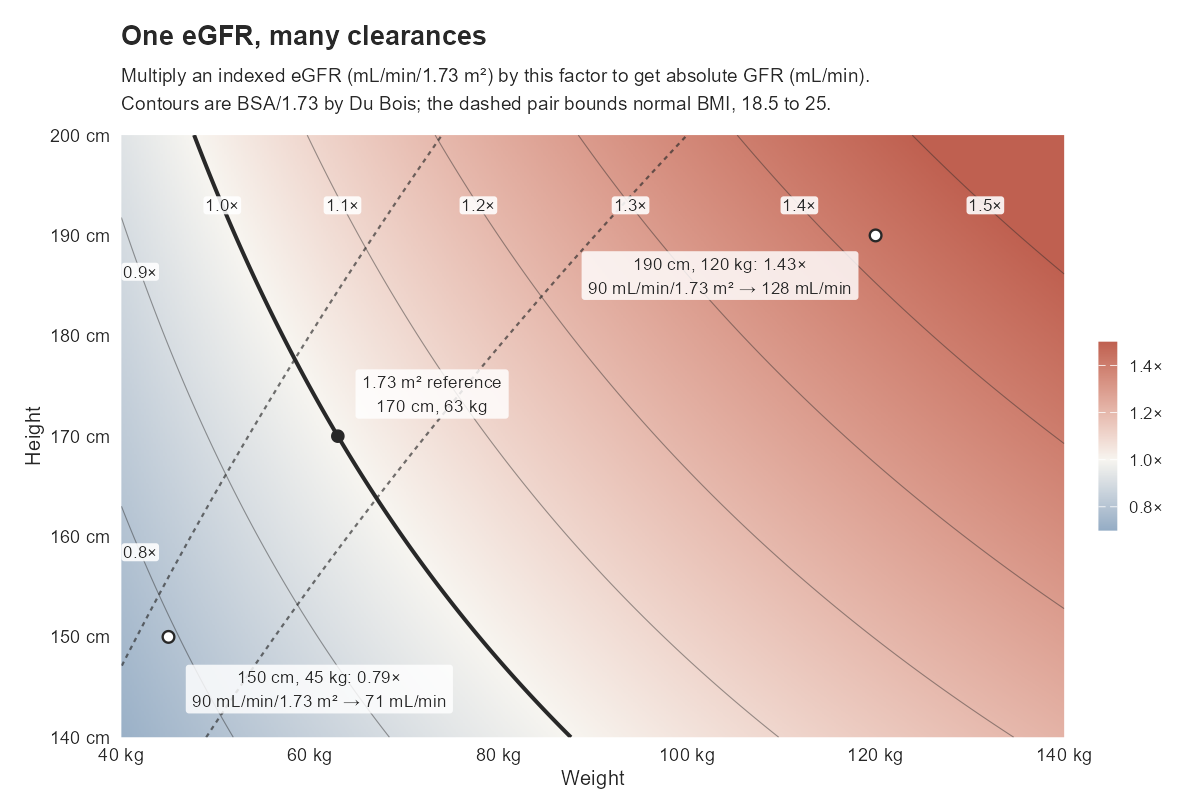
Between the two bodies marked in Figure 1 the factor runs from 0.79× to 1.43×. The same reported eGFR of 90 mL/min/1.73 m2 is 71 mL/min in one and 128 mL/min in the other, a 1.80-fold spread hidden inside a single number on a lab report. This is not an obesity correction either. Staying inside the dashed corridor, a 150 cm adult at the lower bound and a 190 cm adult at the upper bound sit at 0.77× and 1.26×, so the same 90 mL/min/1.73 m2 is 69 mL/min in one and 114 mL/min in the other. That is why indexing misleads at the extremes of body size [2], and why renal impairment studies ask for absolute GFR to be recovered in each individual.
Read a body off the figure, or convert one directly:
BSA here is Du Bois and Du Bois [3], which both the figure and the calculator use. Mosteller is the usual alternative and does not agree with it: across bodies of BMI 18.5–40 it sits between 2.7% below and 5.8% above Du Bois. The formula therefore belongs in the methods whenever a de-indexed GFR is reported.
Unit conversions
Clinical labs report these markers in either unit, so data pooled across sites usually needs converting before any of the equations above are applied.
| Marker | Conversion |
|---|---|
| Creatinine | mg/dL \(\rightarrow\) μmol/L: multiply by 88.4 (divide to reverse) |
| Bilirubin | mg/dL \(\rightarrow\) μmol/L: multiply by 17.1 (divide to reverse) |
Bilirubin is the hepatic counterpart, and feeds the Child-Pugh score used to grade hepatic impairment.
ke for aminoglycosides
\[ \ke = 0.00293(\mathrm{CrCL}) + 0.014 \]
References
[1]
Inker LA, Eneanya ND, Coresh J, Tighiouart H, Wang D, Sang Y, et al. New Creatinine- and Cystatin C–Based Equations to Estimate GFR without Race. N Engl J Med 2021;385:1737–49. https://doi.org/10.1056/NEJMoa2102953.
[2]
Delanaye P, Mariat C, Cavalier E, Krzesinski J-M. Errors induced by indexing glomerular filtration rate for body surface area: Reductio ad absurdum. Nephrol Dial Transplant 2009;24:3593–6. https://doi.org/10.1093/ndt/gfp431.
[3]
Du Bois D, Du Bois E. A formula to estimate the approximate surface area if height and weight be known. Arch Intern Med 1916;XVII:863. https://doi.org/10.1001/archinte.1916.00080130010002.